The Jackson Laboratory

Muscular Dystrophy Models & Efficacy Studies

Muscular dystrophy (MD) refers to a group of genetic neuromuscular disorders characterized by progressive skeletal muscle weakening and wasting. MD includes Duchenne Muscular Dystrophy (DMD), an X-linked progressive neuromuscular disorder caused by variants in the DMD gene that result in the dysfunction or absence of the dystrophin protein, with an incidence of 1 in 3,500 male births.

JAX offers a highly-validated collection of mouse models for neuroscience research and drug discovery, paired with expertise in developing comprehensive preclinical solutions tailored to your MD study goals. When you partner with JAX, we bring developer-based knowledge of MD mouse models and Ph.D.-level study directors to every project - delivering thoughtful, comprehensive project design and execution to your research.

Connect with the JAX Preclinical Services Team

The Jackson Laboratory - Muscular Dystrophy Models and Efficacy Studies

JAX MD Models

See all MD Mouse Models at JAX

Common Strain Name

Type of Muscular Dystrophy
PhenotypeDisease LatencyDetails

B10 mdx
(001801)
Duchenne Muscular Dystrophy

  • Abnormal ambulation & strength
  • Abnormal muscle morphology
  • Cardiomyopathy
3 weeks

D2-mdx
(013141)
Duchenne Muscular Dystrophy

  • Abnormal ambulation & strength
  • Abnormal muscle morphology
7 weeks

mdx-4Cv
(002378)
Duchenne Muscular Dystrophy

  • Abnormal strength
  • Abnormal muscle morphology
 
  • Muscle fiber necrosis
  • Muscle fibrosis
  • Centrally-nucleated skeletal muscle fibers

LGMD2A*
(031211)
Limb-girdle Muscular Dystrophy Type 2A

  • Late onset
  • Mild muscle atrophy
  • Muscle fatty infiltration & inflammation
 
  • Muscle fiber necrosis
  • Muscle fibrosis
  • Centrally-nucleated skeletal muscle fibers

HSA-MCM FLExDUX4
(005750) crossed with (008710)
Facioscapulohumeral Muscular Dystrophy

  • Phenotype is induced by tamoxifen (TMX) injection in the bigenics: most often between 8-12 weeks of age (this becomes D1 of the study)
  • Decreased muscle function 10-14 days after injection
  • Weakness rapidly progressing after 2 TMX injections
 

*Cryopreserved Strain

Muscular Dystrophy Preclinical Studies with JAX

Efficacy studies for muscular dystrophy are performed by JAX Preclinical Services Team using mouse models for the following diseases: B10.mdx and D2.mdx for DMD, DyW for Merosin-Deficient Congenital Muscular Dystrophy Type 1A (CMD1A), and A/J for dysferlinopathy.

Available tests include:

  • Ambulation & Strength
    • Open field test
    • Grip strength
    • Isometric force measurement
    • Righting reflex (for early onset models)
  • Muscle Damage
    • Serum CK
    • Evans Blue dye uptake
  • Inflammation
    • Immunohistochemistry
    • Cell sorting
  • Morphology
    • Histological slides
    • Automated morphometry measurements

Additional mouse models and tests are available by request. Please enquire.

Consult About Your Muscular Dystrophy Study Today

Preclinical Efficacy Studies for Muscular Dystrophy

Example 4-Week In Vivo Protocol Using JAX B10.mdx Mice

Sample Study Design

10 mice per group
4-week dosing period
Daily dosing (route dependent on PK and mechanism of action)

Enrollment & Baseline

Mice enrolled prior to disease onset (timing is model-specific)
Baseline measurements taken at enrollment:

  • Serum biomarkers (CK, AST, ALT)
  • Grip strength
Serum Biomarkers

Baseline & Week 4

  • Creatine kinase (CK)
  • Aspartate aminotransferase (AST)
  • Alanine aminotransferase (ALT)
Muscle Function*

Week 4

  • Grip strength test
  • Non-invasive isometric force measurement of the tibialis anterior (TA)
Exercise Intolerance*

Week 4
2 Methods

  • Method 1: rapid decline in TA force across a series of repeated contractions
  • Method 2: short-distance treadmill run to exhaustion

Post-mortem tissue analysis is available.
*Optional readouts available for muscle function and exercise intolerance.

Example Efficacy Study with B10.mdx Mice

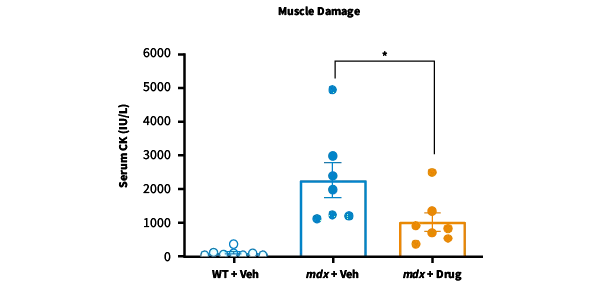
Example Efficacy Study with B10.mdx Mice - Muscle Damage: Serum CK levels were measured to evaluate drug efficacy in reducing muscle damage. CK levels were reduced in drug-treated B10.mdx mice compared to vehicle-treated controls.

C57BL/10ScSn-Dmdmdx/J Strain #001801
Serum CK levels were measured to evaluate drug efficacy in reducing muscle damage. CK levels were reduced in drug-treated B10.mdx mice compared to vehicle-treated controls.

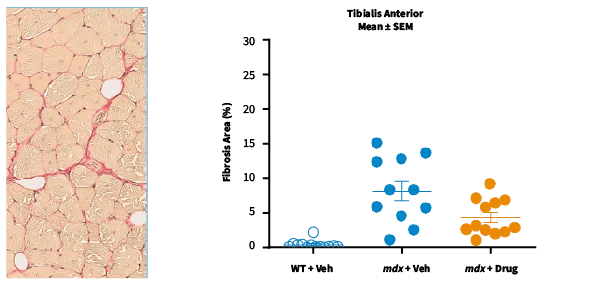
Example Efficacy Study with B10.mdx Mice - Tibialis anterior sections were stained to evaluate drug efficacy on skeletal muscle fibrosis. Fibrotic area was quantified in the tibialis anterior of experimental and control mice using Sirius Red staining on histological slides.

C57BL/10ScSn-Dmdmdx/J Strain #001801
Tibialis anterior sections were stained to evaluate drug efficacy on skeletal muscle fibrosis. Fibrotic area was quantified in the tibialis anterior of experimental and control mice using Sirius Red staining on histological slides.

Example Efficacy Study with B10.mdx Mice - Fibrosis of Tibialis Anterior: Vehicle-treated wildtype mice show minimal fibrosis in the tibialis anterior muscle compared to vehicle-treated B10.mdx mice. Drug-treated B10.mdx mice show reduced fibrosis compared to the vehicle-treated mutants.

C57BL/10ScSn-Dmdmdx/J Strain #001801
Fibrosis of Tibialis Anterior: Vehicle-treated wildtype mice show minimal fibrosis in the tibialis anterior muscle compared to vehicle-treated B10.mdx mice. Drug-treated B10.mdx mice show reduced fibrosis compared to the vehicle-treated mutants.

Preclinical Neurobiology Services

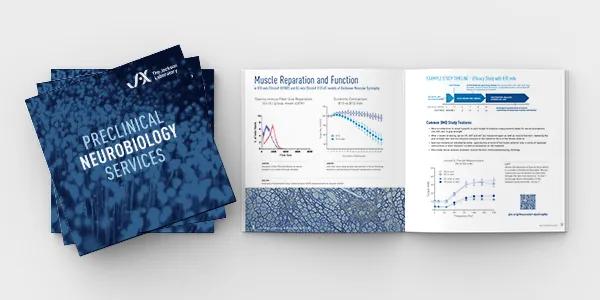
Access our guide to JAX Preclinical Services to learn how we can support your muscular dystrophy research. View key mouse models, details on routes of administration, behavioral and physiological assay menus, and example study designs, alongside supporting resources such as biospecimens, iPSCs, and custom model generation.
Read the Guide

Not what you're looking for? Find more resources

Visit our Resource Hub

The Jackson Laboratory - Preclinical Neurobiology Services Guide

Discover More

Sign Up | JAX Pulse
Stay informed about our events, blogs and videos, and cutting-edge research platforms.

©2026 The Jackson Laboratory