
Transforming ovarian cancer research with patient-derived organoids
Article | March 25, 2026
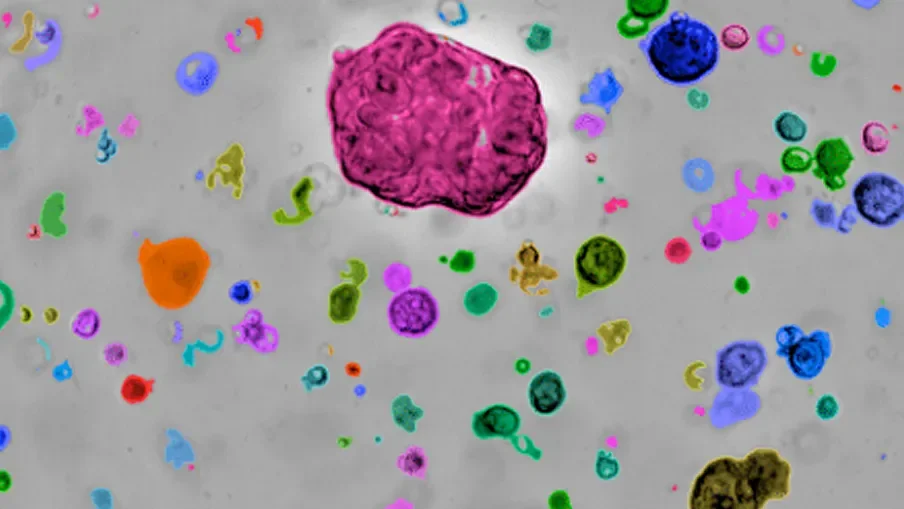
Like many cancers, the risk of developing ovarian cancer increases with age, with most cases occurring after menopause. By the time it’s diagnosed, ovarian cancer has often already spread through distal tissue. Coupled with the fact that it develops through unique pathways in different patients, finding the right therapy is often a race against time.
To change that and give researchers a new way to study the disease, Senior Research Scientist Laura Andres-Martin grows tiny 3D replicas of patients’ tumors at the JAX-NYSCF Collaborative.

Since 2018, Andres-Martin has built a living biobank of patient-specific mini-tumors (called organoids) aimed at capturing the complexity of ovarian cancer. Using technology designed to expand stem cells present in tissues, Andres-Martin cultivates them in the lab, using gels that mimic the natural environment of their cells. This allows the organoids to grow indefinitely and retain the same mutations as a patient’s tumor cells, modeling how each patient-specific cancer develops.
Ovarian cancer is notoriously tricky to treat, with tumors behaving and responding very differently to therapies even within the same patient. By preserving this heterogeneity in the lab, Andres-Martin studies how specific tumors react to various drugs.
Precision medicine in practice
“Even within the same cancer type, patients’ tumors are going to behave and respond to therapies very differently. That's why personalizing the research and understanding how different therapies can be applied is very, very important,” Andres-Martin said.
Scaling these experiments requires more than just expanding patient tissue. Andres-Martin’s group has introduced automation, using robotics to test hundreds of drugs simultaneously. This approach improves experimental reproducibility and enables scale, while allowing researchers to probe the unique features of each tumor.
“We’re testing drugs and compounds, including those used in the clinic to recapitulate patient’s responses, but also drugs in clinical development so that we can discover new responses or new sensitivities,” Andres-Martin said. “Instead of testing a few drugs, we can test hundreds simultaneously.”
Now, the lab is pioneering work involving the immune system to better understand why ovarian cancer generally fails to respond to immunotherapy. Using induced pluripotent stem cells, the lab is generating natural killer cells — a type of immune cell that patrols and destroys cancerous or infected cells. Probing these cells against the patient-derived organoids developed in Andres-Martin’s lab could help reveal why some tumor cells succumb while others resist. This work is supported by the Ralph and Ricky Lauren Foundation.
A vision for the future
The lab aims to connect this work with aging, a major risk factor for ovarian cancer. With age, precancerous cells that normally are kept in check by the immune system may transform into cancer. By modeling fallopian tubes, where most aggressive ovarian cancers originate, the team aims to trace how mutations accumulate and how age-related changes in immune control contribute to tumors.
“What used to be a one-size-fits-all approach, we can now study in a context much more specific to each patient and then test and engineer different scenarios at a scale that we couldn’t before,” Andres-Martin said. “We believe we can really move the needle to improve outcomes by accelerating discovery and drug development with this technology.”
Learn more
Stronger together: Fueling the future of medicine
Our organizations are joining forces to tackle some of the world’s greatest health challenges.
View more
JAX-NYSCF Collaborative
The Jackson Laboratory’s acquisition of the New York Stem Cell Foundation unites complementary strengths across mouse, cell and computational models.
View more