
Article | January 13, 2026
A new stem cell–based platform developed at The Jackson Laboratory (JAX) is shedding light on one of the biggest mysteries in genetics: why the same disease-causing mutation can affect people in dramatically different ways—from severe symptoms to no symptoms at all.
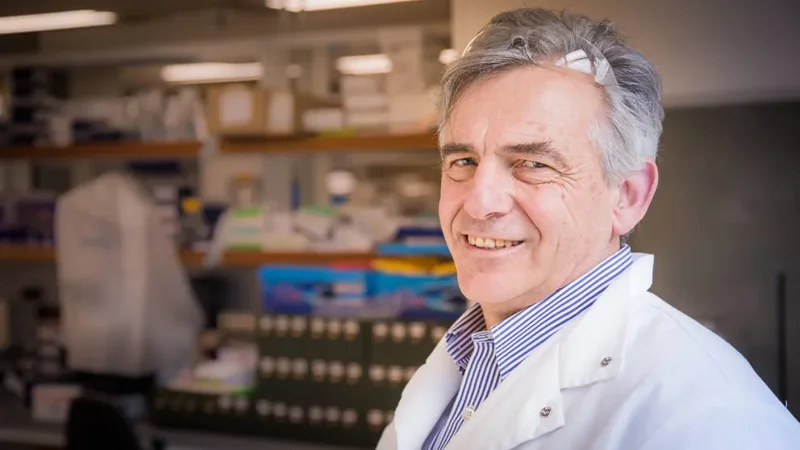
Developed by JAX Professor Martin Pera, the platform uses induced pluripotent stem cells (iPSCs) from eight genetically distinct strains of mice. The breakthrough allows scientists to grow brain cells reliably from each strain, a major technical advance that opens the door to studying many other disease-linked genes in a more realistic and scalable way.
Transcript
Shedding light on genetic backgrounds
The platform enables brain cells to be reliably grown from stem cells derived from eight genetically diverse mouse strains. This scalable platform reveals how the same genetic mutation can produce dramatically different outcomes—from devastating disease to little or no effect—depending on genetic background, opening new possibilities for studying disease-linked genes in more realistic and predictive ways.
To demonstrate the power of the approach, Pera focused on a gene called DYRK1A, which plays a key role in brain development and is associated with conditions like autism, microcephaly, and intellectual disability.
He introduced the same DYRK1A mutation into iPSCs from each mouse strain and coaxed those stem cells to form neurons. Despite having the exact same genetic change, the neurons responded very differently depending on their genetic background. Some looked like healthy human brain cells. Others resembled neurons seen in patients with autism or microcephaly.
Capturing rare but dangerous reactions
“How can one mutation cause such different effects?” Pera explained. “It comes down to genetic background. Each strain has a unique genetic makeup that can either protect against or magnify the impact of that mutation.”
To confirm these findings in living organisms, Pera introduced the same mutations into live mice from the same eight strains. Remarkably, the neurons in the brains of these mice phenotypically matched what he had seen in the petri dish, providing powerful validation that the stem cell system can predict how mutations play out in real animals.
“This is a turning point,” said Pera. “By combining stem cell technology with genetic diversity, we now have a platform that can uncover why diseases affect people differently and how we might tailor treatments to their individual biology.”
“If we had only studied one strain of mouse, we would’ve completely missed this,” said Daniel Cortes, who spearheaded the work as a postdoctoral researcher in Pera's lab. “By using genetically diverse models, we can begin to understand what makes some people more vulnerable to disease and how others might be more resilient.”
This approach also bridges a critical gap in biomedical research: linking what happens in a petri dish to what happens in a living organism. Behaviorally, the team confirmed that mice carrying the DYRK1A mutation on certain genetic backgrounds didn’t survive, while others did, showing how the same gene change can have life-or-death consequences depending on inherited traits.

This is about more than one gene,” said Pera. "It’s about building models that reflect the true diversity of human biology. That’s the key to developing precision treatments that actually work for real people.”
Learn more
The Pera Lab
The Pera Lab studies human pluripotent stem cells to explore self-renewal, pluripotency, and genetic factors influencing neural regeneration and repair.
View more
Human iPS Cells | The Jackson Laboratory
Explore The Jackson Laboratory’s catalog of high-efficiency human iPSC lines for Alzheimer's, ALS, and neurodegenerative research. Discover CRISPR-edited human iPS cells, revertant controls, and tools for precise disease modeling.
View more