
The Jackson Laboratory

Models for Preclinical Parkinson's Disease Research

Parkinson's disease (PD) is multifactorial, demanding investigation across multiple mechanisms and presenting unique preclinical research challenges. JAX's validated PD models and services are built to meet them.

Ready to Discuss Running a PD Study with JAX? Talk to an Expert

The Jackson Laboratory - Models for Preclinical Parkinson's Disease Research

In Vivo Parkinson's Disease Models

JAX's portfolio of translatable PD models is organized by key gene targets to help you identify the best model for your research.
View the JAX Suite of Parkinson's Disease Models in the JAX Repository

Gba1

Common NamePhenotypeDisease LatencyDetails

Gba D409V KI
(019106)
KI & Floxed

  • Homozygous mice show a significant reduction in Gba1 protein level and glucocerebrosidase activity, and a significant increase in glucosylsphingosine in both brain and liver tissues
8 months
  • Cognitive & motor impairment by the age of 12 months
  • High levels of soluble monomeric α-synuclein in the hippocampus at 12 months

^ Back to Top of Page

LRRK2

Common NamePhenotypeDisease LatencyDetails

BAC Lrrk2-G2019S
(012467)
Transgenic

  • Age-associated decrease in striatal dopamine by 12 months
  • No loss of dopaminergic neurons or behavioral motor deficits
3 months
  • Mitochondrial abnormalities & neuroinflammation by 3 months
  • Motor impairment by 18 months

BAC LRRK2 (G2019S)
(018785)
Transgenic

  • Altered glutamatergic synaptic transmission in midbrain DA neurons by 12 months
5 months
(females)
  • LRRK2 G2019S expression exacerbates PFF-mediated α-syn aggregation and degeneration pathology in mice
  • Hyperlocomotion and increased exploratory behavior by 12 months in males and by 5 months in females

^ Back to Top of Page

Ndufs2

Common NamePhenotypeDisease LatencyDetails

cNdufs2- (MCI-Park)
(036313)
Conditional KO

  • Progressive neural and behavioral decline, with mild deficits starting after around postnatal day 30 and becoming overt by day 100
  • Mitochondrial abnormalities, dopamine deficiency & neuronal loss by 3 months
2 months
  • Motor deficits by 3 months
  • By age 60 days, TH expression decreases in substantia nigra dopaminergic neurons
  • Survival less than 6 months

^ Back to Top of Page

Parkin

Common NamePhenotypeDisease LatencyDetails

Parkin KO
(006582)
KO

  • Mitochondrial abnormalities & dopamine deficiency by 3 months
3 months
  • Motor deficits by 5 months

^ Back to Top of Page

Pink1

Common NamePhenotypeDisease LatencyDetails

Pink1 KO
(017946)
KO

  • Mitochondrial abnormalities by 3 months
2 months
  • Reduced spontaneous locomotor activity and skill reported at 3-6 months

^ Back to Top of Page

SNCA

Common NamePhenotypeDisease LatencyDetails

Snca-; PAC-Tg(SNCAWT)
(010710)
KO & Transgenic

  • No phenotype
N/A
  • Experimental control mice for strains that model the early gastrointestinal dysfunction in the absence of major central nervous system pathology seen in human Parkinson's disease

Snca-; dbl-PAC-Tg(SNCAA53T)
(010799)
KO & Bitransgenic

  • Gastrointestinal dysfunction by 3 months
2 months
  • Neurons in the enteric nervous system develop α-synuclein pathology
  • Neurons in the brain are spared: no evidence of dopaminergic neuron loss
  • Motor impairment by 6 weeks

A53T α-synuclein transgenic line M83
(004479)
Transgenic

  • Homozygous mice develop a progressively severe motor phenotype
8 months
  • Alpha-synuclein inclusions, with dense accumulation in the spinal cord, brainstem, cerebellum and thalamus by 8-12 months
  • Impaired odor discrimination at 6 months

mThy1-hSNCA line 15
(017682)
Transgenic

  • Progressively increasing expression of human αSyn starting at 4 weeks
1 month
  • Proinflammatory gut microbiome at 2 months

Hualpha-Syn(A53T) transgenic line G2-3
(006823)
Transgenic

  • Age-dependent phenotype including progressive motor deficits, intraneuronal inclusion bodies and neuronal loss
N/A
  • Clinical abnormalities by 10 months
  • Astrocytosis in the midbrain, deep cerebellar nuclei, brainstem and spinal cord
  • Abnormal neuronal accumulations of α-Syn & ubiquitin by 4 months
  • Loss of dopaminergic neurons

Line 61 (mThy1 hα-syn Tg)
(038796)
Transgenic

  • Alpha-synuclein inclusions by 1 month
  • Mitochondrial abnormalities by 4 months
  • Progressive dopamine deficiency in the striatum starting at 14 months
1 month
  • Motor impairments as early as 1 month
  • Neuroinflammation in the striatum (1 month) and the substantia nigra (5-6 months)
  • Non-motor impairments by 3 months

hm2α-SYN-39
(008239)
Transgenic

  • Progressive impairment in motor function
2 months
  • Neuroinflammation starting at 1 month
  • Abnormalities in the dopaminergic system, including low dopamine levels and difficulties with motor coordination (13 months)

^ Back to Top of Page

FAQs for Parkinson’s Disease Mouse Models

Series of Gene Replacement Models for PD

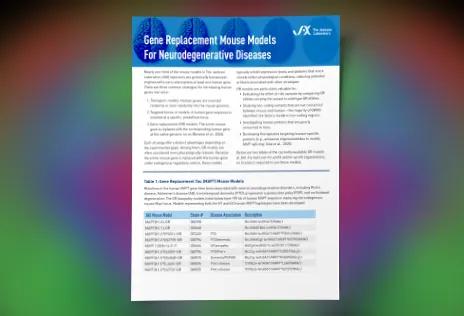
Explore JAX's currently available gene replacement models for neurodegenerative diseases. Gene replacement models are often considered more physiologically relevant, as the entire mouse gene is replaced with the human gene under endogenous control. These models typically exhibit expression levels and patterns that more closely reflect physiological conditions.

Read the PDF

Not what you're looking for? Find more resources

Visit our Resource Hub

The Jackson Laboratory - Gene Replacement Mouse Models For Neurodegenerative Diseases

Sign Up | JAX Pulse
Stay informed about our events, blogs and videos, and cutting-edge research platforms.

©2026 The Jackson Laboratory